



Do More in Four? Why the 4-Day work week is a business imperative; not a perk
By Pheebe Hewitt, Head of Marketing at HBHR
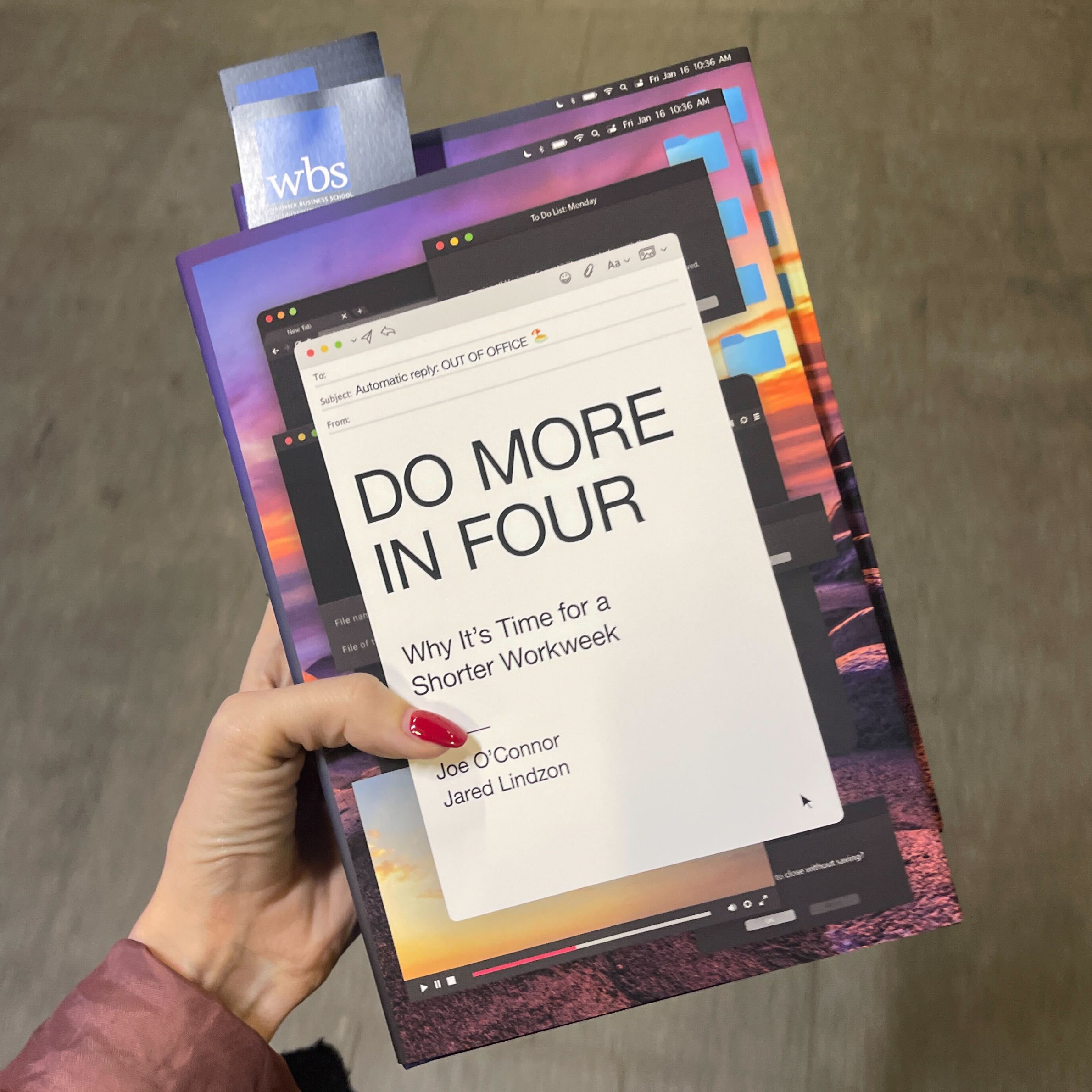
Last week, Hayley McCole (Head of PR & Comms at HBHR) and I attended a Harvard Business Review-backed event at The Shard in London, centred around the new book Do More in Four, written by Joe O'Connor and Jared Lindzon.
The book draws on more than 18 years of research between Joe & Jared, with both having dedicated the last 8 years to global trials into reduced working time. But what struck me most wasn't just the concept of a four-day work week, it was the broader question: is working a five-day work week REALLY beneficial in this century, and why is everyone talking about it? We have drawn from our own research and think that from an HR perspective, the four-day week may not be the only answer, but it is forcing the right questions.
In short: productivity is up. Wages aren't. One of the most powerful statistics shared at the event compared productivity growth and wage growth over the below time periods:
-
1948-1973:
Productivity ↑ ~96%
Real average hourly compensation ↑ ~91%
→ Productivity and pay rose largely in tandem. -
1973-2013 (sometimes updated to later years):
Productivity ↑ ~74%
Real hourly compensation ↑ ~9%
→ Clear decoupling between productivity and wages.
(Source- Joe O'Connor, author)
In the 1980s, when output increased, reward followed. Today, output continues to rise, largely driven by AI, automation, better systems, better technology and smarter machines, but working patterns have barely evolved?
In a knowledge economy powered by artificial intelligence and digital tools, "time spent" is no longer a reliable measure of value. Output from workforce and how we measure that has fundamentally changed. We are no longer in a factory working economy, where for example 8 hours of efficiency can be measured in how many garments your workforce can make. The work week is increasingly different, so why is nobody open to change?
We can't forget that the five-day working week was once considered revolutionary! Henry Ford implemented it in the early 20th century not out of altruism, but because it clearly improved productivity and created consumers with time (and money) to spend. It was a commercial decision rooted in economic reality. While the decision was primarily routed in business, it was also influenced by the growing acceptance of a two-day weekend that accommodated two major religious traditions in the US at the time: the Sabbath/Sunday balance. In 1908 a New England cotton mill first introduced a 5-day week to allow Jewish employees to observe the Sabbath on Saturday while not working on Sunday, the traditional Christian day of rest. This is interesting, but where do we draw the line?
Every major shift in working patterns, throughout history, has followed technological advancement. The Industrial Revolution changed labour. The digital revolution changed knowledge work. Now AI is redefining output from staff entirely. So, the question becomes: is the four-day work week the next logical evolution?
This isn't about working less, it's about working differently, maybe working smarter? One misconception addressed repeatedly during the event was that a four-day week means cramming five days into four. But that model doesn't work. The successful trials across the UK, Iceland, New Zealand, the US and beyond — focus instead on redesigning work:
- Eliminating low-value meetings
- Reducing presenteeism
- Automating repetitive tasks
- Tightening decision-making processes
- Clarifying accountability & outcomes
The result? In many cases:
- Productivity maintained or improved
- Revenue remained stable or increased
- Burnout reduced
- Retention improved
- Employee engagement rose
This shift forces organisations to confront an uncomfortable truth: a surprising amount of the traditional work week is now inefficient.
We also can't ignore the wellbeing data. Burnout rates remain very high. Absenteeism linked to stress continues to rise across generations. At the same time, there is a clear generational shift in expectations: younger employees increasingly prioritise flexibility, purpose and wellbeing, while many senior leaders built their careers in high-presence, high-hours environments. This inevitably creates tension. To some, a four-day week feels entitled; to others, it feels overdue.
The commercial reality, however, is that talent expectations are changing. Organisations that fail to evolve risk losing high-performing individuals to those that will. The four-day week trials highlight something critical: when employees feel trusted and measured on outcomes rather than hours, performance improves. And in HR, we know culture drives performance far more than policy does. The four-day week may not be the only answer, but it is asking the right questions.
Another compelling point raised was around the broader economic stimulus of increased leisure time. When people reclaim hours, they spend differently: wellness, fitness, education, community, all things that would benefit an economy in a ripple effect. Reduced working time doesn't just affect employers. It can affect economies.
Henry Ford understood that rested workers become active consumers. We may be entering a similar moment. The controversial question to ask; if AI continues to increase productivity year on year, and businesses continue to benefit from efficiency gains — is it reasonable to expect humans to simply absorb that acceleration indefinitely? Or should technological progress buy back time for employees?
Historically, innovation reduced labour hours.
Now, innovation often increases performance pressure.
That's a model worth interrogating.
So, in conclusion, is the Four-Day work week the future of work?
Not universally.
Not blindly.
Not without operational redesign. But dismissing it outright would ignore:
- 17+ years of global research
- Growing AI-driven productivity shifts
- Burnout trends
- Changing generational expectations
- Commercial evidence from successful pilots
For HR leaders, this is not a lifestyle debate. It's a workforce strategy conversation.
At HBHR, we see daily how policy, culture and technology intersect. The future of work will not be defined by location alone, but by structure, trust, and intelligent design.
The four-day week is not a silver bullet. But it may well be the catalyst that forces organisations to rethink what work is actually for. And we think that's a conversation worth having.